Sustainability at KAMAT: Taking Responsibility for the Future

As a family-owned company in its second generation, we at KAMAT pursue a sustainable vision. Our long-term orientation is deeply rooted in our corporate culture – and, since 2025, also systematically verifiable through our certification to the ZNU Standard “Sustainable Management”. We are convinced that sustainability must be practised at all levels in order to secure the continued existence of our company for many more years and generations to come. In doing so, we rely on concrete, measurable goals against which we transparently track our progress.

Our efforts span several areas:

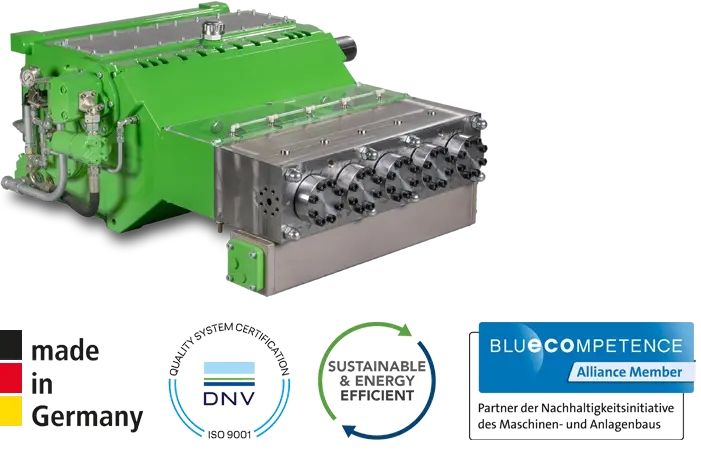
  1. Environmentally friendly products: We rely on modern solutions to develop environmentally friendly products. Our high-pressure pumps and systems are designed to conserve resources and minimise energy consumption. In this way, we make an active contribution to environmental protection.
  2. Resource-efficient production: In manufacturing our products, we ensure the efficient use of materials and energy. We continuously optimise our production processes in order to reduce our ecological footprint.
  3. Commitment to our employees: Our employees are the heart of our company. We support their development and place great value on a healthy working environment. Because only satisfied and motivated employees can contribute to KAMAT’s success in the long term.
  4. Economic stability: For us, sustainability also means economic stability. We rely on long-term partnerships with our customers and suppliers – and continue to advance sustainability together along the entire supply chain. In this way, we create a solid foundation for KAMAT’s continued existence in a constantly changing world.

Our quality promise is based on more than 50 years of experience in high-pressure technology. We develop tailor-made solutions that are durable, low-maintenance and individually adapted to our customers’ needs. Discover the performance of our high-pressure technology and let us master the challenges of the future together.

Sustainability thrives on dialogue with all of the company’s stakeholders. If you have any questions or comments regarding sustainability at KAMAT, or would like to exchange ideas with us on this topic, please contact us at info@kamat.de.

Die Funktion von Hochdruck Plungerpumpen

ZNU Certification: Sustainability with a System

At KAMAT, sustainability is not just a buzzword, but a living corporate practice. Since 2025, the company has been certified according to the recognised ZNU standard ‘Sustainable Management’. This standard considers ecological, economic and social aspects equally and thus makes sustainable action measurable, comparable and continuously developable.

The certification supports us in integrating sustainability into all areas of the company in a structured manner. From resource-saving production and fair working conditions to responsible corporate governance.

It is particularly important that the ZNU standard not only requires a one-time audit, but also verifiable progress on an annual basis. This ensures that our commitment has a long-term impact – for our customers, employees, partners and the environment.

Taking responsibility. Shaping the future. Systematically.

Die Funktion von Hochdruck Plungerpumpen
Selected Objectives of Our Sustainability Strategy

As a mechanical engineering company, we take responsibility for shaping a sustainable future – environmentally, economically, and socially. Our sustainability strategy is based on the UN Sustainable Development Goals (SDGs) and focuses on measurable, long-term progress. Here are selected objectives that reflect our commitment to climate protection, quality, and workforce development.

In the course of further developing our management system, we have reviewed and sharpened our sustainability goals – with the aim of making their achievement even more measurable and traceable. This does not mean that existing objectives lose importance: they remain part of our sustainability activities and consistently pursued

Environment – SDG 13 (Climate Action)

Our goal: We will reduce our direct emissions (Scope 1) per employee by around 15% by the end of 2030 compared with the 2025 base year.

As a mechanical engineering company, our direct COâ‚‚ emissions arise primarily from the energy used in our buildings and from our vehicle fleet. Reducing Scope 1 emissions per employee helps us to use resources more efficiently, lower fuel and energy costs, and make an active contribution to climate protection.

We are implementing the following measures:

  • Reducing heat loss at the factory hall doors
  • Optimising heating operation
  • Training employees to raise awareness and ensure optimal use of heat
  • Training all field staff in resource-efficient driving
Progress over time
  2025 (base year) 2026 2030 (target)
Scope 1 emissions per employee 1.48 t CO₂e/employee – 1.26 t CO₂e/employee

Economy – SDG 12 (Responsible Consumption and Production)

Our goal: We will increase the share of assessed suppliers with documented sustainability measures to 65% by 2030.

We maintain a close, long-term cooperation with our suppliers. As sustainability also plays an important role in the supply chain, we want to continuously increase the share of suppliers with demonstrable sustainability efforts. We promote this in particular through regular dialogue and close cooperation with our suppliers, in order to advance sustainability together along the value chain.

We are implementing the following measures:

  • Expanding supplier assessments and audits to include detailed sustainability criteria
  • Regular supplier audits, including a review of sustainability efforts
  • Integrating sustainability into our purchasing policy
  • Active dialogue with suppliers on the topic of sustainability
Progress over time
  2025 (base year) 2026 2030 (target)
Share of suppliers with documented sustainability measures 48% – 65%

Social – SDG 3 (Good Health and Well-being)

Our goal: We aim to ensure that 60% of our employees use more than 40% of the employee offerings.

Our employees are an essential part of KAMAT’s success. To further increase their satisfaction, we are optimising our employee offerings, among other things, so that their average usage increases. The 2025 employee survey serves as the base year.

We are implementing the following measures:

  • Regular review of usage through employee surveys
  • Adapting the offerings based on survey results
  • Improved internal communication about the employee offerings
Progress over time
  2025 (base year) 2026 2030 (target)
Share of employees using more than 40% of the employee offerings 53% – 60%
Related Links to Sustainability at KAMAT
Sustainability Guidelines
Projects